
Your website can carry case studies, testimonials, certifications and a process diagram and still leave your most important claim unverified. The problem is usually not missing proof. It is whether that evidence supports the same proposition and scope as the claim you are asking a buyer to act on. I call that mismatch the verification gap.
The verification gap
The verification gap appears when a consequential claim cannot be traced to evidence that supports the same proposition.
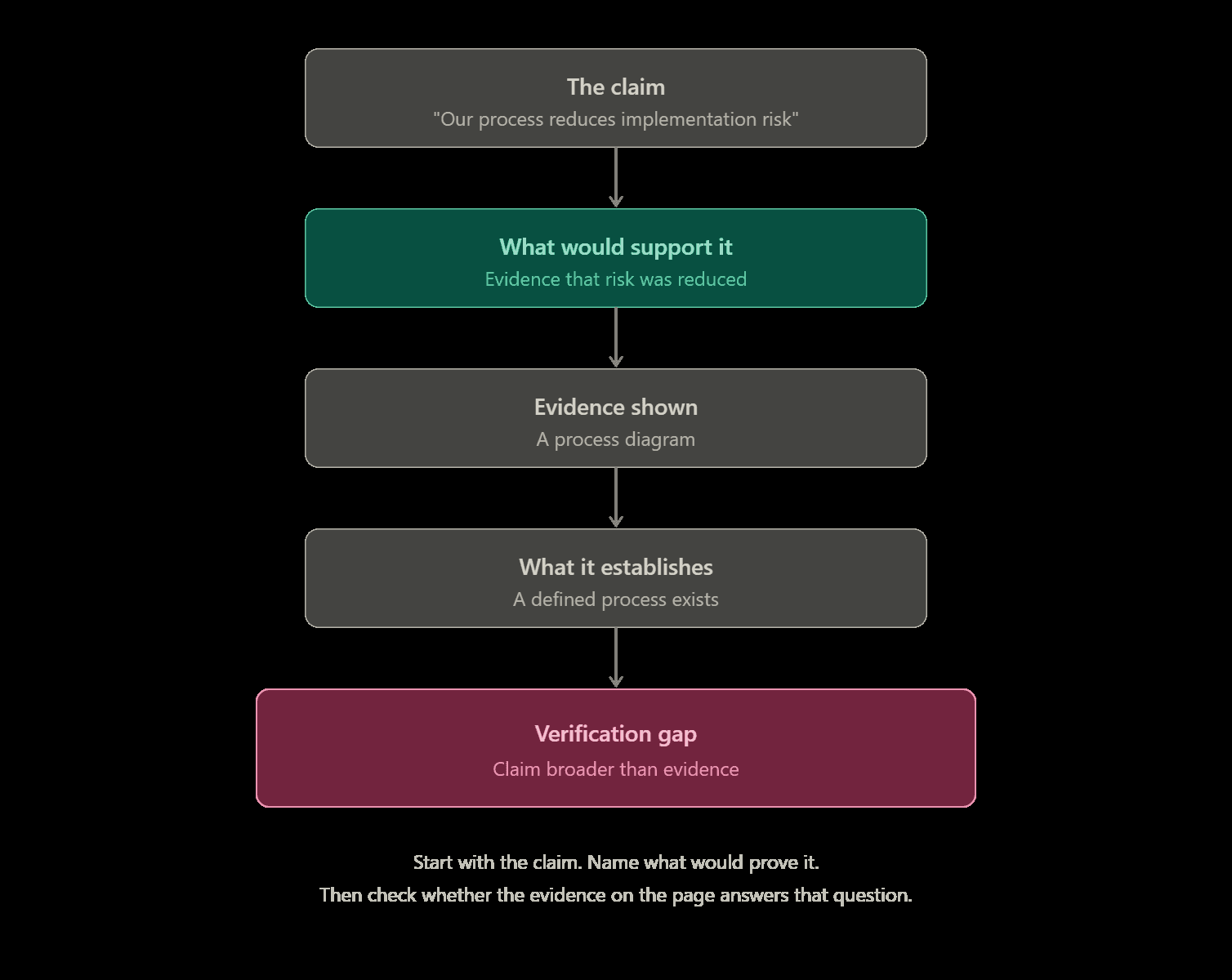
This mechanism is easy to test. Take the claim "our process reduces implementation risk." A process diagram may show that a process exists, but it cannot by itself demonstrate that risk was reduced. The diagram can be authentic and useful while still supporting a different proposition. The gap is not whether your page looks credible. It is whether the evidence matches the claim.
Formal procurement gives the distinction a useful boundary. UK government supplier-selection guidance says supplier evidence should be independently verifiable where possible and that contracting authorities should conduct due diligence and validate evidence where possible. It also says evidence should be proportionate to the assessment. That guidance concerns public procurement, not website copy, so I use it for the verification principle rather than claiming every procurement team applies a proposal rubric to a homepage. Module 6: Supplier selection
You can check this without trusting me. Take one vendor page, a competitor's or your own, isolate one important claim and cover the rest of the page. Then ask what evidence would have to exist for that sentence to be true at the scope stated. Uncover the surrounding proof and compare it with that requirement. If the evidence answers a different question, the gap remains.
A polished claim can create confidence, but confidence and verification are different jobs.
Why your claims do evaluation work
A claim rarely has to persuade only one person. In a B2B purchase it can travel from the person reading your site to an internal champion, a manager, a technical reviewer, procurement or a decision-maker, and context tends to fall away at each handoff. You are not in the room to explain what the sentence was supposed to mean. So the question quietly changes: it stops being "do I believe this company?" and becomes "can I show someone else why this claim is reasonable to rely on?" Those are different statements, and only the second one survives the room you are not in.
Your website is not only a brochure during evaluation. A 2020 TrustRadius study summarized by MarketingProfs surveyed 907 B2B technology buyers and reported that 51% relied on vendor websites when evaluating potential technology purchases. That is evidence about technology buyers in that study, not a universal rule about every procurement team, but it means your public claims are often doing evaluation work whether you intend it or not. The Information Sources B2B Tech Buyers Most Rely On
A website still does not become the procurement file. UK supplier-selection guidance shows why: formal assessment can involve legal and financial capacity, technical ability, exclusion grounds and evidence proportionate to the contract. A public page cannot replace those checks. Its narrower role is to make the vendor's claims, boundaries and evidence paths inspectable before or alongside deeper diligence. Module 6: Supplier selection
Different evidence answers different questions
The useful question is not whether proof exists nearby, but whether the available evidence supports the exact claim a buyer is being asked to use.
A case study can evidence a bounded piece of previous work. A testimonial records an attributed person's assessment or reported experience. A process description can show how a vendor says work is organized. A certification can substantiate only the status or scope it actually certifies. None of these formats proves every broader claim placed beside it.
TrustRadius's 2024 B2B Buying Disconnect report drew on 2,164 verified technology-buyer responses and 243 technology-vendor responses. It says case studies remained vendors' top tactic even though buyers consistently placed them low among resources consulted, while the vendor or product website was the only resource appearing in both sides' top-five lists. 2024 B2B Buying Disconnect Report: The Year of the Brand Crisis
That does not mean a website beats a case study, or that one proof format is inherently stronger. Evidence quality cannot be judged independently of the proposition it is being used to support. Start with the claim, identify what the artifact actually establishes, then compare scope with scope.
Run the claim-to-evidence check on your own page
I use a five-step check, the Claim-to-Evidence Check, because you can run it on your own page without private analytics or a sales explanation. Choose the claims that would matter most if a buyer or an internal stakeholder repeated them to someone who never spoke to you, then put each one through the same five steps in order. The fifth step is the one that gives you a vocabulary for what you find.
- Write down the claim exactly as published. If you cannot state what it asserts without rewriting it, the first problem is specificity.
- Name the evidence that would support that exact assertion. Do not accept a nearby logo, testimonial or case study merely because it looks like proof.
- Follow the public evidence path. Check whether the reader can reach relevant support from the page without needing someone to explain what the claim was supposed to mean.
- Compare scope with scope. Evidence from one project, customer, certification, period or product does not automatically support a broader statement.
- Classify the result: supported, partly supported, unsupported on the public page, or claim broader than evidence. That classification is the diagnosis; it is not permission to invent stronger proof.
What the research does and does not support
A 2014 survey of 175 B2B buyers summarized by MarketingProfs found demand for different kinds of vendor-site information, including product or service information, company information, testimonials and substantive content such as case studies and whitepapers. The study is old, so I do not use its percentages as a current benchmark. I use it only to show that different information can answer different evaluation questions. What B2B Buyers Want From Vendor Websites
Prompt research produced the same caution. When I asked one assistant on September 8, 2026 what procurement teams look for on vendor websites, the answer quickly blended procurement, security, technical evaluation and general B2B buying. A comparison prompt also pulled marketing advice that treated one proof format as inherently persuasive. This is one assistant observation, not a study or measurement.
The contamination matters because formal procurement evidence can tell us what due diligence values, while buyer surveys can tell us which resources respondents used. Neither lets me say that every procurement team scores every website against the same criteria. The verification gap is a diagnostic principle, not a claim that one website-scoring model is in use.
Where website structure enters the diagnosis
A verification gap can belong to one sentence. When it does, the repair is local: narrow the claim, connect the evidence that supports it, or remove an assertion the page cannot carry.
When the same pattern repeats across your homepage, your service pages, your proof and your offer explanation, the problem has changed shape. Your buyer is no longer tripping on one unsupported line. They cannot reconstruct the relationship between what you claim, what you actually do, what evidence supports it and what they should do next. Rewriting an isolated sentence does not fix that. It is the structure through which your business asks a buyer to understand and verify it.
If that wider diagnosis fits your site, that is where the High-Signal Website Build becomes relevant.
That link is not a promise of procurement approval. The service page says you see the words and the structure before the full build, and asks you to judge the work before buying, which is the same standard this article applies to everyone else.
End on the evidence path
An unverifiable claim is functionally equivalent to no claim when an evaluator needs evidence, because the gap is verifiability, not credibility.
That does not mean every sentence needs an external citation or every internal document belongs on the public site. The GOV.UK guidance ties evidence to relevance and proportionality. The public-page version is simpler: the stronger and more consequential the assertion, the clearer its evidence path should be. Module 6: Supplier selection
The diagnosis is not that every vendor needs more proof; it is that consequential claims need an evidence path proportionate to what they ask a buyer to believe.
That is the difference between looking credible and closing the verification gap.