
A B2B contact-form non-submission tells you where the conversion attempt stopped, but not necessarily why. The same outcome can be consistent with interface friction or with a buyer not yet having enough reason to initiate contact. I treat the drop-off as a diagnostic signal, not automatic proof that the form itself is the problem.
The visible problem is not automatically the cause
A form can create real friction. Extra effort, confusing fields, unnecessary disclosure, poor mobile behavior, or unclear instructions can all make an interaction harder to complete. I treat that as a legitimate hypothesis when a contact form underperforms.
A non-submission tells you where the observable conversion attempt stopped; by itself, it does not tell you why.
That distinction matters because two different problems can produce the same visible result. If I assume the form is the cause before I have evidence, I can optimize the interface while leaving the actual decision problem untouched.
Why form optimization is the conventional diagnosis
The conventional response to poor form conversion is reasonable: reduce fields, simplify the interaction, clarify the next step, improve mobile usability, and test whether the form is asking for too much. It is also the explanation you will meet first, in the search results and from an AI assistant.
Usability research shows that unnecessary form burden can create friction. Baymard's checkout research is ecommerce, not B2B lead forms — enough to establish the burden is real, not to prove it is your cause. Checkout Optimization: Minimize Form Fields – Baymard
The problem begins when a plausible hypothesis is treated as a proven diagnosis. A contact form can be difficult to complete. It can also be perfectly usable and still appear at a point where the buyer has not established enough reason to initiate contact.
The commitment gate
I use the commitment gate as a diagnostic model for the point where anonymous evaluation is asked to become an identifiable interaction with the seller. The buyer is not necessarily making a commercial commitment. They are deciding whether to cross from researching into contact.
B2B buyers can use digital self-service for substantial parts of information gathering and evaluation while still turning to people for context, validation, or fit. One Gartner survey covered 632 B2B buyers, a later one 645, and McKinsey's 2024 B2B Pulse included nearly 4,000 decision makers. Together, they describe buying environments that mix digital and human interaction rather than a single linear path into sales contact. Gartner Sales Survey Finds 61% of B2B Buyers Prefer a Rep-Free Buying Experience Gartner Survey Finds 69% of B2B Buyers Turn to Sales Reps to Validate AI-Generated Insights Five fundamental truths: How B2B winners keep growing
I treat the form as the visible interface at this gate. But the fact that the buyer did not cross it does not establish whether the barrier was the interface or the decision to initiate contact.
One outcome, two different hypotheses
The same non-submission can be consistent with two materially different hypotheses: difficulty completing the interaction or insufficient reason to initiate it.
Picture two visitors leaving the same page on the same afternoon. The first has already decided to contact you. She opens the form, reaches a required field asking which budget band she falls into before she knows what the work costs, and closes the tab. The second reads everything twice and never touches the form, because nothing on the route told him whether you have done this for a business shaped like his.
Both of them show up in your analytics as the same thing: a form that was not submitted. One of them needs a shorter form. The other would have filled in twelve fields if the page had given him a reason to.
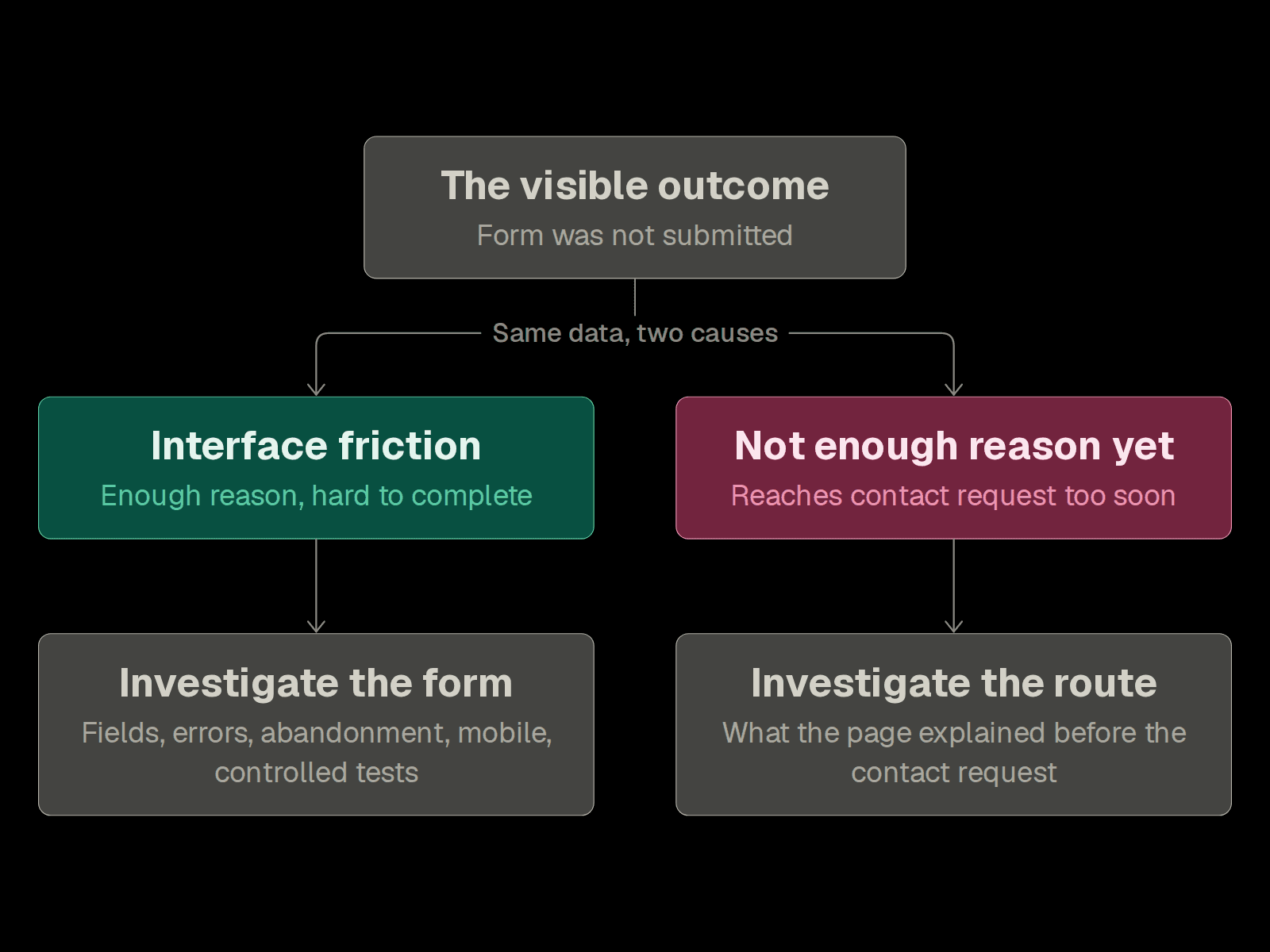
These are not the only possible causes of non-submission. I separate these two because they are materially different hypotheses that call for different investigations.
- Interface friction. The buyer has enough reason to continue, but the interaction itself creates unnecessary effort, confusion, resistance or disclosure burden. Look for evidence in the form and in the mechanics of completing it.
- Insufficient reason to initiate contact. The buyer reaches the request for identification without yet having enough basis to decide that contact is warranted. Look beyond the form, at what the route let the buyer understand before the request appeared.
What non-submission can and cannot tell you
A contact-form conversion rate can tell you how often the measured action occurred. It can show where a route is losing people and help locate a problem worth investigating.
It cannot establish purchase intent, motivation, trust, readiness, or whether a particular field caused the decision not to submit. It also cannot establish that the problem sits upstream of the form. Those are causal interpretations, and the outcome alone does not provide them.
This is where I turn form optimization into a diagnostic question: what evidence can distinguish the competing hypotheses?
What evidence would separate the hypotheses?
I use the evidence already available to test the two hypotheses before deciding what deserves to change.
No single signal should be asked to prove more than it can. Long time on page does not prove purchase intent. A session recording does not automatically reveal motivation. A lower conversion rate does not prove that fewer fields will solve the problem.
Before changing the form, determine which hypothesis the available evidence actually supports.
If the evidence does not isolate the form, gather better evidence rather than promoting a guess into a diagnosis.
- Define the measured failure point. Record the page, form, device context, and action that did not occur so you know exactly what the conversion data is describing.
- Test the interface-friction hypothesis. Review form interaction data, technical or usability findings, field-level errors or abandonment, and controlled tests for evidence that completing the interaction itself is creating unnecessary difficulty.
- Test the insufficient-reason hypothesis. Review qualitative buyer research, inquiry patterns, and what the route explains before the contact request for evidence that a buyer may reach the form without enough basis to decide that contact is warranted.
- Separate observation from interpretation. Mark what the evidence directly shows and what you are inferring; do not use dwell time, session recordings, or conversion rate alone as proof of motivation or cause.
- Choose the next investigation from the stronger evidence. If the form is isolated, investigate the interaction. If the issue extends beyond it, investigate the surrounding conversion route. If neither hypothesis is supported, collect better evidence before changing the page.
Why the distinction changes the optimization question
The distinction changes what a change to the form is allowed to prove. If interface friction was the problem, a shorter form that lifts the conversion rate is evidence. If the problem was a missing reason to make contact, that same shorter form may still lift the same number, from a smaller and different set of people, and tell you nothing about the buyers you were trying to reach. Same intervention. Same direction of travel. Only one of them is a diagnosis.
That is the practical value of the commitment gate. It keeps the visible form in view without automatically granting it causal ownership of the drop-off.
The form is one component of a wider conversion route. When the problem cannot be isolated to the form itself, the relevant diagnostic unit becomes the system around the next step.
When the evidence points beyond the form
A form problem and a conversion-system problem are not the same diagnosis. The first asks whether the interaction is unnecessarily difficult. The second asks whether the wider qualification, routing and follow-up logic makes sense as a system once an inquiry does arrive — and, where it bears on what reaches the business at all, whether the route into that request is doing its part.
If the evidence suggests the issue cannot be isolated to the form, I expand the diagnostic unit to the wider conversion system. Conversion System Design
Make the decision the evidence supports
If the evidence isolates interface friction, keep the investigation on the interaction. If it points to insufficient reason to initiate contact, examine the route before the request. If neither explanation is supported, do not choose a fix yet — improve the evidence.
The decision is not whether forms matter. It is whether the evidence supports changing the form, investigating the route around it, or gathering better evidence before either.